No, we’re not all Buddhists
When I was at school, classmates and even teachers would wonder what my religious background was. Once during Chinese New Year one of my primary school teacher approached me with the eagerness to learn about Buddhism. I found myself somewhat puzzled by this since I was only a young boy who hardly understood what Buddhism entailed, nor was I familiar with its practices. The only impression that came to mind were the golden statues of Buddha frequently depicted in Chinese temples or Shaolin monks from martial films. Reflecting on it, this assumption appears quite innocent, yet it highlights a prevalent misunderstanding in the West that simplifies Chinese culture to a singular, easily identifiable label of religion.
This association between Chinese people and Buddhism is as inaccurate as asserting that everyone in the Western countries are Christians. In fact the reality is more complex, and often intertwined with cultural and family values. Much of this is influenced by Confucian principles and age-old customs rather than formal religious identification. In general cultural conversations and media portrayals, British Chinese are often assumed to follow a religion that doesn’t reflect the full range of our beliefs and cultural traditions.
In this post, I will try to challenge this stereotype and explore what religious practice and belief really look like in the Chinese community in modern Britain.
Origins of the Stereotype
The belief that all Chinese individuals practice Buddhism did not emerge without basis. It is rooted in extensive historical and cultural contexts. No doubt for over a millennium, Buddhism has been prominently present in China and played a huge role in shaping Chinese culture. Monks, temples, and the well-known symbols of Buddhas and pagodas have made the faith easily recognizable to outsiders. When Western missionaries and travelers came across China in the 19th and early 20th centuries, they frequently simplified a vast and intricate religious landscape into a single, identifiable category: Buddhism. Other belief systems, such as Taoism, folk religion, ancestor worship and Confucian ethical frameworks were just as prominent, yet Buddhism seems to be recognised as a much more symbolic representation of East Asian religion.
The stereotype was later reinforced by films, television, and advertising that have portrayed Chinese and East Asian characters as mystical and exotic tropes, oversimplifying all diverse nuances into a familiar cliché. The visual shorthand of Buddhist monks, incense smoke, temples and gong sounds became the cinematic language for “the Far East.” From early Hollywood to modern blockbusters, Buddhism has been used as an aesthetic to signify and represent Chinese culture.
In the 20th century, films like The Good Earth (1937) or The Sand Pebbles (1966) portrayed Chinese characters within a moral and religious vacuum that Western saviours often “filled.” Later martial arts films and TV series such as Kung Fu (1972), associated Chinese identity with serene monk-like discipline, echoing Zen Buddhist tropes that had more to do with Western perceptions than Chinese religiosity. Scholars have noted that this pattern reflects a broader Western tendency to categorise “the East” according to familiar frameworks, institutionalised, doctrinal religions over fluid, culturally embedded practices.
The portrayal of Chinese people in media, coupled with limited historical accounts, has reinforced stereotypes that result in frequent assumptions and the exotification of Chinese people from Western perspectives. Consequently, the question, “What religion are you?” has evolved from a straightforward inquiry into a subtle expression of a fixed idea regarding spiritual and religious practice, which rarely aligns with our actual experiences.
The Reality of Religious Practice in the UK Chinese Community
The picture of Chinese religiosity in the UK is far more complex than the stereotype suggests. While some British Chinese do identify as Buddhist, many do not and even those who do may practice in ways that differ from Western expectations of faith. Religion in the Chinese diaspora is often less rigid that blends culture ritual and ethics, rather than being purely doctrinal or institutional.
You can find Chinese Christian churches thriving in London, Manchester, and Birmingham, serving both as places of worship and as community hubs for immigrants. There are also smaller Chinese Muslim communities, such as the Hui diaspora. At the same time, a significant portion of British-born Chinese identify as secular or atheist, yet continue to engage in rituals tied to family, culture and ancestry. These traditional folk religion, that diffuses nature makes it almost invisible in British census data and academic reports. Because it doesn’t demand exclusive membership or belief, most people who practice its rituals would still tick “No religion” or “Other” on forms.
Recent Census data provides a more nuanced picture of religion within the British Chinese community, challenging the assumption that most Chinese people are Buddhist. According to the 2021 ONS Census, the majority of people identifying as Chinese in England and Wales around 60 to 65% reported having no religion, reflecting both a secular trend and the cultural distinction between spiritual practice and formal religious affiliation. According to a report by the Bible Society (2023), the Chinese community in Britain: “Christians (both Catholics and Protestants) make up 23% of the Chinese population in Britain.”, reflecting the growth of Chinese church congregations in the UK, while only a minority (approximately 9.5%) identified as Buddhist.
This diversity illustrates that religion in the Chinese diaspora cannot be understood as a single, uniform identity. Practices are often situational: some rituals are performed for luck, some for moral continuity, and some for spiritual meaning. Many who identify as “Buddhist” are cultural Buddhists, participating in rituals without necessarily embracing formal religious doctrine. In this context, singular religious categories oversimplifies a rich mosaic of beliefs and practices that intertwine faith, culture and family tradition.
There’s no straight answer to “What Religion Are You?”
For many ethnic Chinese in the UK, the question “What religion are you?” is deceptively simple and often impossible to answer. Western frameworks of religion expect a singular, clearly defined affiliation: a personal commitment to a belief system and an institution. But traditional Chinese religious life, especially in the diaspora rarely fits this mold. Belief and practice are often fluid and intertwined with culture rather than formal faith.
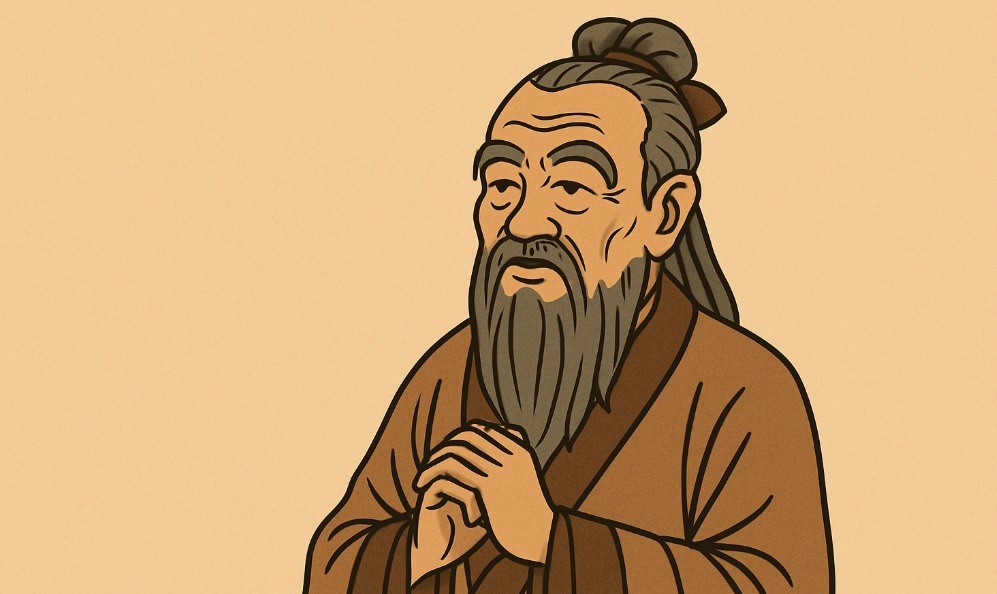
Confucianism plays a vital role in shaping these practices. Confucian values profoundly influence family life, moral obligations and ritual observance. A family might burn incense for ancestors, consult feng shui or attend a temple during festivals, without considering these acts “religion” in the Western sense. Others may identify as a Christian or Buddhist but still maintain Confucian-inspired moral practices or participate in folk rituals.
Academic research has argued that the notion of a single religious category is a Western-centric perspective that fails to acknowledge the cultural and intergenerational diversity. This seemingly innocuous question can actually serve as a subtle tool to misrepresent the religious practices within the Chinese community.
Moving Beyond Stereotypes
Asking “What religion are you?” may be a straightforward question to others, but it overlooks the complexity into an oversimplified label. Similarly with the question; “Are you a Buddhist?” comes with a presumption that rooted in stereotype of Chinese culture. A stereotype that simplifies spiritual practice into a singular recognisable form.
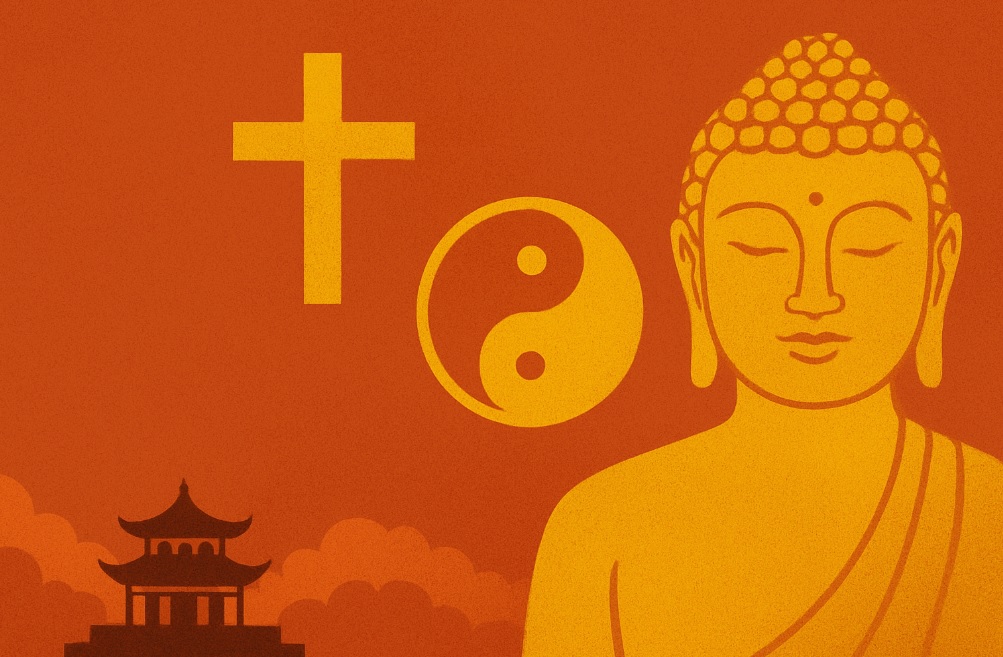
As we’ve come to understand, the reality consists of a spectrum of beliefs and observances, ranging from Christianity and Islam to Taoism, Confucianism and cultural Buddhism. These practices coexist and intertwine, alongside traditional practices and personal interpretation. Spirituality is embedded in traditional culture and community life, and not merely a matter of doctrinal belief or institutional membership.
Understanding this is crucial, as it allows others to move beyond superficial assumptions and gain a deeper appreciation for the cultural fluidity and hybridity of religious beliefs of the Chinese community in the UK. Practices that may appear “religious” to outsiders, such as ancestor worshipping, filial piety and seasonal rituals, are often central to one’s identity and traditions. Embracing this complexity allows us to see the diaspora not as a monolithic religiosity, but as a community whose spiritual beliefs are as diverse and vibrant as its people.