A Space in Transition
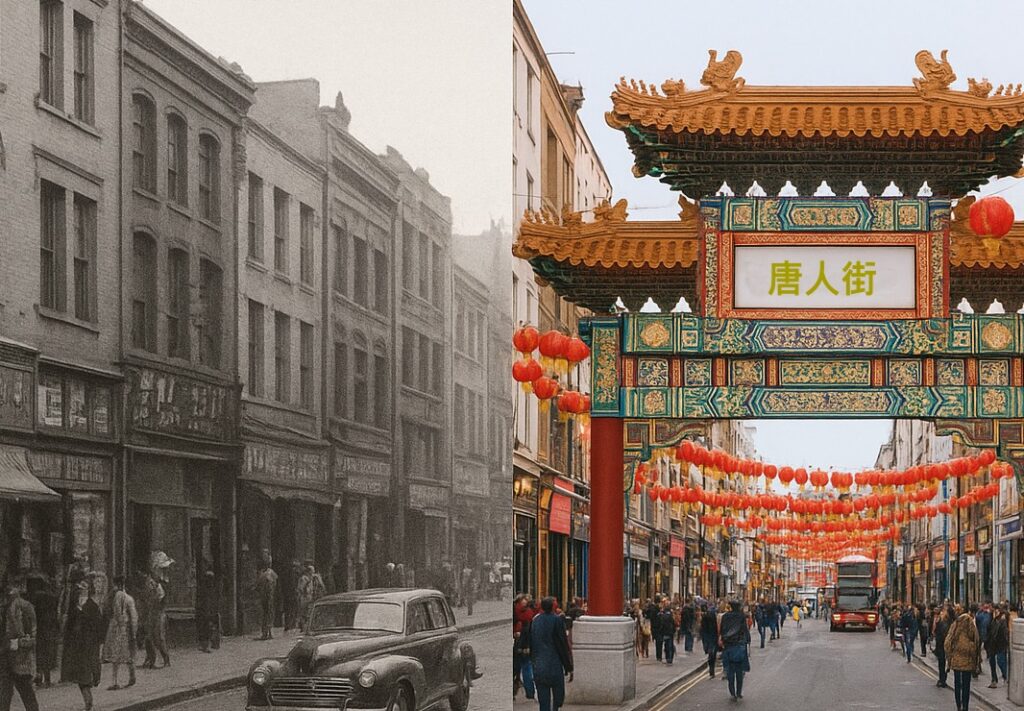
Walking through the streets of Chinatown we are greeted with a vivid scene of red lanterns hanging overhead, neon restaurant signs with the smell of roast meat wafting through the air. To visitors the scenery feels exotic and exhilarating. For many in the British Chinese community, these streets were meant a cultural hub of belonging: a place to find familiar food, speak Cantonese without hesitation or stocking up for their businesses. Today, they are just as likely to be crowded with tourists, cameras in hand, searching for the perfect Instagram shot or queueing up for the newest bubble tea or dessert shop.
Over the years, the bustling streets of Chinatowns have undergone significant changes, with various businesses and revamps coming and going. But do we still consider Chinatown the beating heart of the community, rooted in the history we identify with? Or has it become a performance space curated and staged for outsiders’ enjoyment? And perhaps more importantly, what role will it play in the future, as gentrification reshapes its landscape and when younger generations move onto suburban spaces and integrate into the mainstream British culture?
We shall look at Chinatown as a site of identity and belonging, as a contested space threatened by commercial development, and as a shared arena that might hold potential for inclusivity and connection. In doing so, we asks whether Chinatown can continue to evolve as both a home for the community and a bridge to the wider public.
Identity vs. Performance
For much of its history, Chinatown served as a lifeline. Early migrants, many arriving from Hong Kong’s New Territories after the Second World War, built communities in these enclaves where they could buy familiar groceries, connect with other Cantonese speakers, and a place to find work for new settlers. In an unfamiliar culture that often felt unwelcoming, Chinatown was built on survival. It represented a ‘home’ away from home.
Nowadays, the significance of Chinatown in Britain feels more complex. On one hand, it continues to hold deep cultural importance for many British Chinese individuals, serving as a place to reconnect with their cultural heritage, whether through food, language, or festivities. On the other hand, its identity has increasingly been shaped by outside influences.
A report by Middlesex University; Cityscapes of Diaspora: Images and Realities of London’s Chinatown, suggests that the meaning of Chinatown is constantly being redefined through cultural heritage practices, not just by those with Chinese backgrounds, but also by tourists and local authorities who reimagine it through curated events and performances. In this sense, Chinatown has become as much a staged cultural showcase as it is a shared community space.
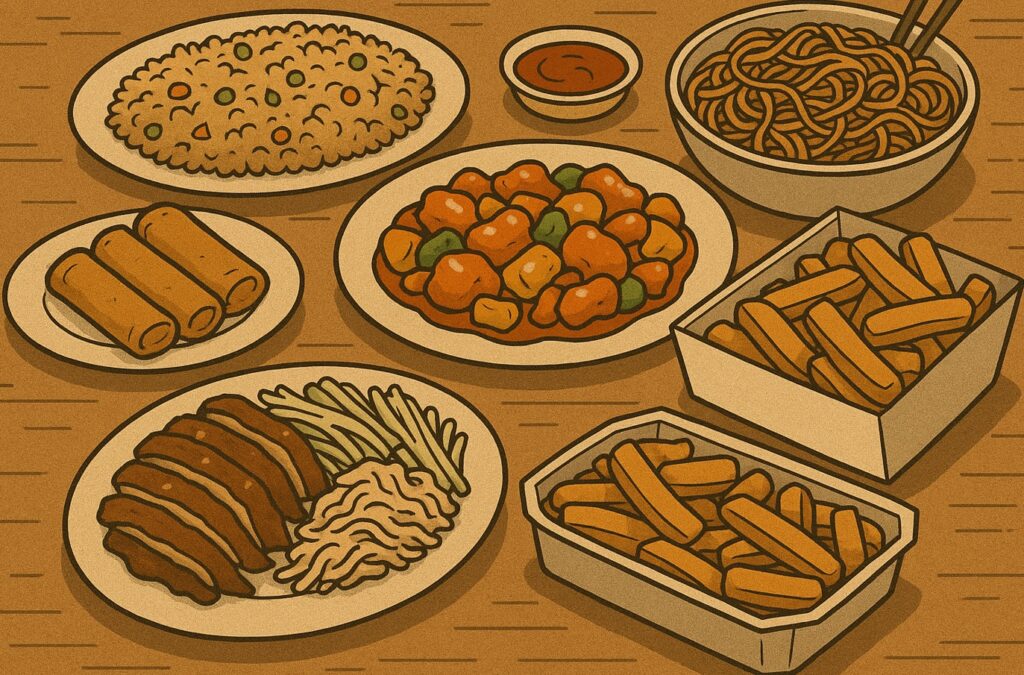
Food culture is perhaps the most obvious example. The traditional Cantonese dim sum restaurants that once anchored Chinatown have been joined by hotpot chains, Szechuan spice restaurants and an endless array of bubble tea shops. While this reflects the diversification of Chinese migration patterns to the UK in recent decades, it also mirrors the growing curiosity of non-Chinese diners seeking novelty and “authentic” experiences. As a result, Chinatown operates as both a cultural archive and a performance stage, caught between preserving its heritage and catering to the interests of outsiders.
Yet, beneath the spectacle, there remains a quieter layer of belonging. A UCL study on Chinatown as an “urban artifice” found that while tourists and non-Chinese locals often see the area as a cultural attraction, ethnic Chinese residents and workers use it in a different way: for socializing, getting familiar goods and preserving their identity. This shows that even though it may not seem important to casual visitors, Chinatown still serves as a support for those who need it, even if its role is less obvious now.
The crux of the matter lies in whether Chinatown is primarily a reflection of how others perceive Chinese culture, or a genuine site where the community constructs its own identity. Inevitably, its dual nature has profound implications for understanding Chinatown’s future.
Gentrification, Displacement & Belonging
The question of identity makes us wonder if Chinatown still represent our community today, gentrification makes this concern even more pressing. Higher property prices and city development projects have put a lot of pressure on long established family-owned businesses that used to be common in these areas. Herbal medicine shops, long-time grocery stores, and old dim sum restaurants are shutting down, replaced by more fashionable pan-Asian restaurants or global chains that attract tourists instead of serving the local community.
Research from Goldsmiths, in collaboration with the Runnymede Trust, highlights how this process has reshaped London’s Chinatown. The report found that many Chinese businesses and residents are being pushed out of Soho because of high prices, with some moving to outer areas to find cheaper living. This matches census data that shows Chinatown still has a lot of ethnic Chinese residents in one area, but many are leaving because of rising costs and changes in lifestyle. In other words, the very people who sustained the enclave are slowly being pushed out of it.
When long-standing shops close, the community loses not just services but also important cultural spots where older generations felt comfortable, where heritage languages traditions continued quietly. A neighborhood that once felt like home starts to look more like a theme park. As a result, belonging becomes broken.
Because of this, Chinatown is in a difficult situation. It is both a place of displacement and belonging; a spot where identity is kept alive and also worn away. The question is whether it can survive gentrification without losing its essence or whether its future will be shaped more by market forces that turn it into a product than by the community it represents.
Chinatown, a Space of Transition & Inclusivity
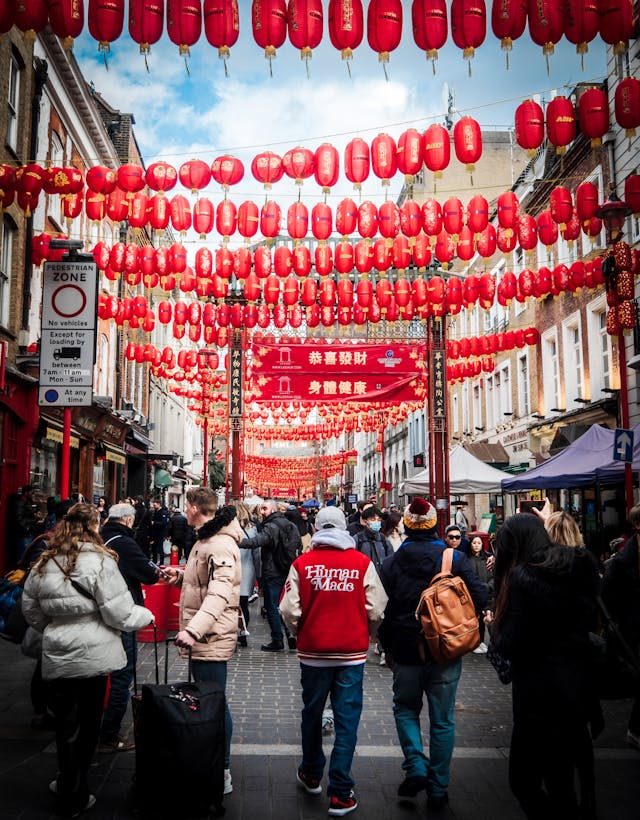
On a brighter note, Chinatown is more than just an ethnic enclave; it serves as a bridge between communities. Through food, festivals, and everyday interactions, it creates opportunities for cultural exchange that go beyond staged performances. Visitors experience traditions firsthand, while younger generations of British Chinese connect with their heritage in a public setting. Events like Chinese New Year invite the wider public into what was once a private ritual, transforming it into a shared celebration.
Economically, Chinatown fosters interdependence, with businesses serving and employing people from all backgrounds. In this sense, it symbolises belonging to the community and acts as a gateway for others to engage with Chinese culture. Rather than being a barrier, Chinatown becomes an inclusive space that demonstrates how cultural pride and integration can coexist. What was once a family-oriented space and ritual has transformed into a spectacle of parades, lion dances, food stalls and fireworks.
This transition is not necessarily a loss. For the community, Chinese New Year in Chinatown remains a time of pride and visibility. It creates a moment where Chinese culture is not marginal but central, celebrated in the heart of the city. For wider society, it provides an accessible way to engage with traditions they might not otherwise encounter, fostering cultural curiosity and understanding. In fact majority of the festival goers nowadays are not ethnic Chinese.
Some might say that these events could weaken their true meaning, changing important traditions into simple entertainment. But they also create new opportunities: a festival that used to be for just one community is now for everyone in the city. In this way, Chinatown is becoming about cultural sharing and exchange. It is not just “ours” anymore but a place we share.
In the Face of Development
The topic of development is very important for the future of Chinatown. On one hand, investment can bring new life to these neighborhoods. In Liverpool, the council’s decision to take back the stalled New Chinatown site shows a renewed commitment to improvement, promising better public spaces and infrastructure. In London, projects like “Love Chinatown” have added outdoor dining and colourful new lantern displays, attracting visitors and keeping the area lively after COVID-19. These changes can boost businesses, protect jobs and help Chinatown remain a key part of Britain’s cities.
However, development also has risks. Projects driven by profit instead of community needs can quickly erode Chinatown’s purpose as it once served. For instance, Liverpool’s first luxury apartment project raised worries that rising rents would push out the businesses that give Chinatown its unique character. Meanwhile, Manchester serves as a warning: without proper investment and community support, it has seen a drop in Lunar New Year sales and important landmarks have fallen into disrepair. Both neglect and too much commercialisation can harm cultural richness. So, the way forward cannot just be about more investment.
Development is important to keep Chinatown lively and relevant, but it must be guided by the community, not forced on it. Affordable rents, protecting heritage and opportunities for cultural expression should be prioritised along with economic growth. When celebrations like Chinese New Year are seen not just as tourist attractions but as real traditions from the community, they can strengthen Chinatown’s role as both a heritage site and a shared community space.
Chinatown Beyond Borders
The story of Chinatown is one of continuity and change. Once a refuge for newcomers, it has evolved into a symbolic center of identity, weathering waves of migration, gentrification, and reinvention. Today, it stands at a crossroads: no longer just the community’s private sanctuary, nor fully surrendered to the demands of tourism. Instead, it embodies both a reminder of heritage and a shared cultural stage.
For the British Chinese community, this duality can feel uneasy. The rising costs and changing character of Chinatown may make it seem less like home and more like a display. However, by sharing it with the wider public, Chinatown gains increased recognition and a place within Britain’s broader cultural society. Festivals like Chinese New Year demonstrate how traditions can honor the past while inviting others in, creating connections that transcend ethnic boundaries.
The future of Chinatown depends on how it navigates this balance. If gentrification strips away the businesses and community anchors that give it depth, Chinatown risks becoming a hollow spectacle. Conversely, if it continues to nurture authentic cultural practices while welcoming broader audiences, it can remain a vibrant bridge between communities. The best direction lies in balance: a Chinatown that welcomes the wider public without losing sight of its culture and historic value. In this way, it can remain both a cultural landmark and a living, breathing home for the community that built it.