“You met me at a very Chinese time in my life”
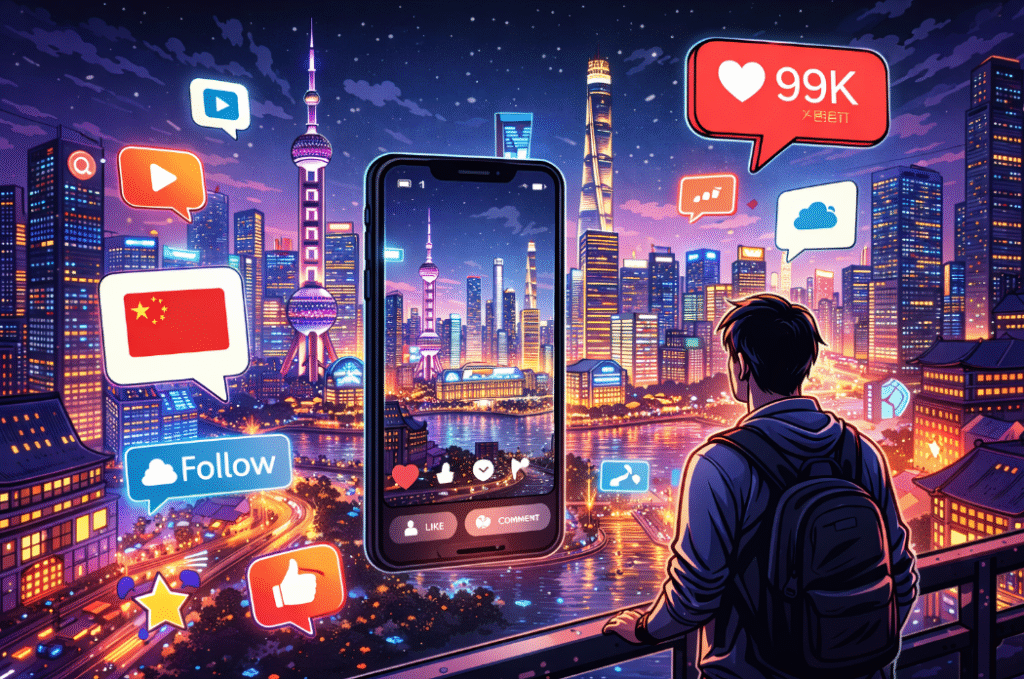
In 2025, a curious digital phenomenon called “China maxxing” spread across Western social media: a viral trend that represents a fascinating intersection of internet subculture lifestyle and aesthetic; a collection of videos, montages and narratives that frame modern China as a symbol of efficiency and future-oriented living. The suffix “-maxxing” from online communities dedicated to self-optimization (such as looksmaxxing or productivity-maxxing), that involves “maximizing” their adoption of Chinese lifestyle habits and aesthetic values.
In some cases, the trend overlaps with older internet humour and cultural commentary, using the tongue-in-cheek caption: “You met me at a very Chinese time in my life.”. The meme, often played with a mixture of curiosity and lifestyle hacks. Videos often paired with motivational audio tracks, suggesting a life “restarted” in a more dynamic environment. The fact that such humour and the newer China maxxing aesthetic can coexist online says something about how China is simultaneously romanticised and reimagined in Western digital culture.
Creators post videos documenting their shift toward traditional and modern Chinese practices. Common behaviors associated with the trend include: drinking hot water instead of iced drinks, boiling apples for health, wearing cheongsam and adopting Traditional Chinese Medicine (TCM) practices like guasha or herbal teas. There is also a significant fashion element. The “Chinese Baddie” aesthetic characterized by sharp, clean-cut makeup and high-fashion street styles from cities like Chengdu.
As someone navigating British Chinese identity, this shift is interesting not because it is unequivocally positive or negative, but because it highlights a tension: China as a montage is very different from China as a lived, complex society, and both are different again from the experience of growing up Chinese in Britain.
This post is not an argument for or against China maxxing. It is an attempt to understand it; where it came from, what it appeals to, whether it risks becoming a new kind of aesthetic orientalism, and what it means when your cultural heritage becomes something others adopt as a strategy for self-reinvention.
From Geopolitics to Western Social Escapism
Historically, China has occupied shifting symbolic roles in Western imagination, sometimes distant and mysterious, sometimes politically threatening, and now, for some audiences, aspirational. The trend reframes China not as an abstract geopolitical actor but as a visual shorthand for modernity itself, the ‘new cool’. This shift may suggest that China is becoming a primary source of “cultural cachet,” similar to the “Hallyu” (Korean Wave).
Scholars and cultural critics suggest that China-maxxing is more than just a fleeting meme; it is a symptom of “Western disillusionment.”. The emergence of China maxxing is best understood as a product of broader cultural and economic moods in the West rather than as a sudden fascination with China itself.
In the digital era, countries are increasingly experienced as visual narratives. Cities become symbols of social confidence, technological progress, and future possibilities. China, with its fast growing cities, fits well into this idea.
Research cited by The Guardian suggests that the rise of the Chinese social app RedNote (Xiaohongshu) in the West has acted as a “de-propagandization device.” By bypassing traditional news outlets, young Westerners are exposed to high-definition “vlog” content showing futuristic skylines in Shanghai and efficient high-speed rail. According to Shaoyu Yuan of NYU’s Center for Global Affairs, this lifestyle content “lowers the temperature” of geopolitical rivalry by creating a sense of cultural familiarity.
The timing of the trend is also important. In parts of the United Kingdom and other Western societies, younger generations have grown up during periods of economic uncertainty, housing pressure, and declining social mobility narratives. Online culture often transforms such structural anxieties into comparative storytelling. Experts point to a “grass is greener” sentiment among Gen Z. Faced with rising housing costs and aging infrastructure in the West, many young people romanticize the “hyper-efficiency” and communal living styles seen in Chinese content.
This does not automatically imply political sentiment. Many participants in the trend appear motivated by curiosity, aesthetic appreciation or dissatisfaction with aspects of Western urban life. The phenomenon is therefore better understood as cultural mood expression rather than a political alignment.
Influencers, Streamers and the Viralisation of China
Another major reason China maxxing gained traction recently is through the role of online personalities (usually non-Chinese) who document their experiences in China to large Western audiences. In the age of streaming and social media, influencers act as informal cultural intermediaries, shaping how millions of viewers perceive unfamiliar places.
Travel vloggers and livestreamers often present China through highly curated experiences: fast trains, mobile payment convenience, dense nightlife districts and futuristic cityscapes. For viewers who have never visited the country, these videos can function as a form of digital tourism and escapism.
A notable example is the American streamer IShowSpeed, whose travel streams in Chinese cities attracted significant attention online. His spontaneous reactions to everyday conveniences, from high-speed rail travel to street food culture generated millions of views and reinforced the impression of China as energetic and technologically integrated.
Similarly, travel vloggers on platforms such as YouTube and TikTok regularly produce content showcasing urban environments in places like Shanghai and Shenzhen. These videos often emphasise convenience and scale: contactless payments, vast metro systems, and late-night city life. In many cases, the tone of these videos is not overtly political. Instead, they follow the familiar structure of lifestyle content: surprise, discovery and comparison. A creator experiences something that feels novel or impressive, then shares it with an audience framed through personal reaction.
Influencers do not necessarily set out to comment on global power shifts, yet their content can reinforce emerging narratives about national momentum, technological modernity, or cultural relevance. For audiences encountering China primarily through these personalities, the country becomes both real and mediated through the lens of a streamer’s experience and excitement. However most influencers jumping on the China maxxing trend intends to gain social validations and followers than providing nuance understanding of its country or culture.
Appreciation or Performance?
The trend is not without controversy however. Critics argue that China-maxxing often flattens a complex, rich culture into a series of “quirky” aesthetic choices, sometimes ignoring the socio-political realities of life in China. A central question surrounding China maxxing is whether the trend represents genuine cultural appreciation, or whether it risks becoming a form of projection onto a simplified image of China.
Historically, Western portrayals of China often leaned toward exoticisation through orientalist lens; framing Chinese culture as distant, mysterious, or fundamentally different. In contemporary online culture, the framing has shifted. China maxxing contents are frequently presented as acts of leisure and lifestyle elevation through domestic habits, technological engagement and holistic rituals. Yet the mechanism is similar. In both cases, culture is reduced to ‘symbolic fragments’ where they can pick and choose whatever Chinese elements they wish to adopt.
Another understated problem in China maxxing is not misunderstanding, but rather the transition from cultural curiosity to cultural performance. The internet makes this process easier by turning a culture into shallow consumable images rather than a willingness to understand culture as lived experience, transforming a rich civilization into a lifestyle brand that only serves as a passing social media trend. Some influencers go as far as claiming to be ‘diagnosed as Chinese’. Which subtly implies (intentionally or not) that being Chinese is considered to be a medical condition.
Cultural Root is More Than a Vibe
Members of the Chinese diaspora have expressed mixed feelings, with some describing the trend as “jarring” or “reductive.” For many overseas Chinese communities in Britain, identity was historically shaped less by public cultural visibility and more by practical everyday life. Chinese presence in British society often existed as a private cultural continuity rather than public cultural spectacle.
Growing up in British Chinese environments during the late 1990s and early 2000s often meant navigating spaces where Chinese identity was present but not particularly fashionable and even ridiculed by others. It was something lived rather than performed publicly. The rise of China maxxing introduces a different cultural dynamic. For British Chinese individuals, identity often exists in a hybrid space. China maxxing does not necessarily resolve that complexity or the way it changes the external perception surrounding the Chinese community.
On the other hand there is also a subtle paradox in diaspora cultural visibility. Does that automatically translate into stronger belonging for overseas descendants? The answer is not straightforward. Cultural belonging is usually formed through lived experience and personal history, however online sentiment such as China Maxxing depends on external validation which adds another layer of uncertainty to cultural identity for oversea Chinese. A sentiment which many feel familiar but equally unsettling.
Identity Maxxing
China-maxxing is a phenomenon where social media trends serve as a coping mechanism for societal dissatisfaction. It reflects Western anxieties about progress, digital culture’s tendency to compress complex societies into aesthetic symbols and a continuing search for places that appear to promise an alternative lifestyle. It signals that young people in the West are actively seeking to escape from the dissatisfaction with the current socioeconomic structure. This is where China maxxing seemed to offer a form of coping strategy, even if it’s only superficial.
For those of us who grew up in British society within a Chinese family, belonging has never been something that could be maximised but rather it’s an experience that spun from languages, memories, family stories and the ordinary spaces between cultures. The China-maxxing trend though offers some positivity, collides with the more textured reality of diaspora identity through a narrative that does not fully reflect our life experience.
On a final note, whether it’s a genuine step toward cross-cultural understanding or just another “aesthetic” to be consumed, it signals a major shift in how the next generation views global influence. At its best, it reflects curiosity about a society that many in the West previously misunderstood or overlooked. It may challenge outdated stereotypes and encourage younger audiences to see China’s modernity as part of the global present rather than just for its historical culture.